How Skill, Luck, and Systems Shape a Game : A Game Designer's Guide
Understanding the statistical foundations that determine whether players win through mastery or chance


Ever wondered why chess feels different from a dice-based board game? One is perfectly predictable, while the other thrives on randomness. This difference is at the core of statistical spaces in game design, and understanding it can help designers craft better, more engaging experiences.
In this article, I’ll try to break down the two fundamental types of statistical spaces -static and stochastic -how they influence gameplay, and why every game designer should care.
What Are Statistical Spaces?
Let’s start by a question; Imagine a card game where every move is calculated versus one where luck plays a huge role. Would you play differently?
Game designers classify these systems as static or stochastic spaces, and understanding them is key to crafting balanced, engaging experiences.
A statistical space is just a fancy way of describing how outcomes are determined in a game. It defines whether results are fixed and predictable or influenced by chance and randomness.
There are two main types of statistical spaces:
Static Spaces – Outcomes are always the same given the same inputs. No randomness involved.
Stochastic Spaces – Outcomes are influenced by probability, randomness, or chance.
Static vs. Stochastic: Examples from Games
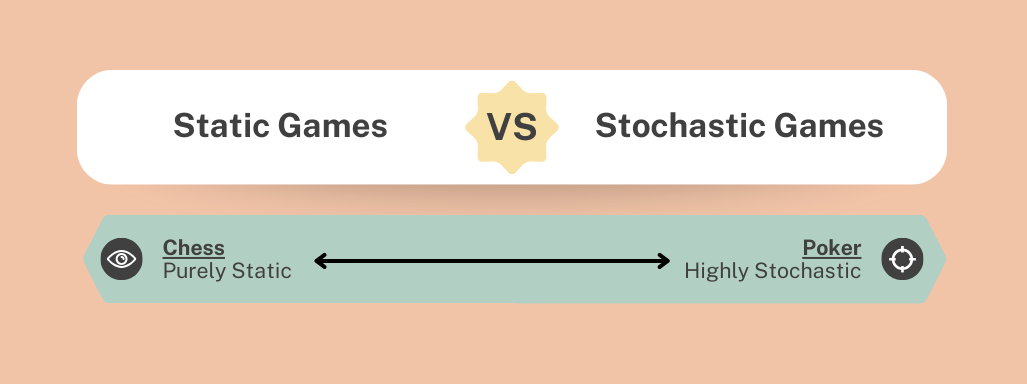
Before diving into examples, it’s important to note that not all games fit completely into these two categories. Instead, individual systems within a game can be classified as static or stochastic. A game may have both static and stochastic systems working together. The following examples help illustrate the difference between these two statistical spaces by highlighting specific systems within well-known games.
Static Spaces (Skill-Driven Games)
These games are entirely deterministic; there’s no luck involved. Every action has a set result, and winning depends purely on skill, knowledge, and strategy.
✅ Chess (Move Selection System) – Every move has a predictable outcome. If both players play perfectly, the better strategist always wins.
✅ Tic-Tac-Toe (Win Condition System) – The game is solvable because there’s no randomness.
Stochastic Spaces (Chance-Based Games)
These games introduce randomness, making them less predictable. Luck plays a role, but strategy can help manage risk.
🎲 Poker (Card Dealing System) – The cards you get are random, but your strategy determines how well you play the hand.
🎲 Dice-Based RPG Combat (D&D- Attack Roll System) – Attack rolls introduce probability, making each battle unique.
🎲 Roguelikes (Level Generation System) – Levels and loot are randomly generated, creating variety and replayability.
Why Does This Matter in Game Design?
How you design your game’s systems (IMO, a game is almost like a machine that consists of many systems working together) affects balance, fairness, and player engagement.
Static Spaces reward skill mastery and planning. They create fair but sometimes repetitive experiences.
Stochastic Spaces add excitement and unpredictability, increasing replayability but making balance more complex (I’ll write about balancing later!)
What’s Next?
I’ll dive deep into static spaces, exploring practical approaches to designing, simulating, and balancing deterministic game systems. We’ll look at concrete examples and methodologies you can apply to your own projects.
I’d love to hear from you:
Do you lean more toward skill-based or luck-based elements in your designs?
What’s your approach to balancing these systems?
As a player, do you prefer games of pure skill or ones with calculated risk?
Drop your thoughts in the comments below. The best game design insights often come from community discussion, and I’m eager to learn from your experiences.